How to Format an Epigraph in MLA Style
- Written by Lucas Street
- Published on 03/02/2026
Many writers choose to begin their books, essays, poems, articles, and so forth with a brief quotation from another author. This brief excerpt–often only a line or two–is called an epigraph, from the Greek word for “inscription.” Epigraphs are primarily “ornamental” (Modern Language Association); that is, they aren’t directly discussed in the writer’s text. Instead, they allude to a theme that will follow in the body of the text.
Much like a good title does, an epigraph aims to pique the reader’s interest, but unlike a title, it does so less directly and with more subtlety. For example, in the bestselling nonfiction book/memoir Just Mercy: A Story of Justice and Redemption, author Bryan Stevenson chooses as his epigraph a quotation from the famed theologian Reinhold Niebuhr that reads “Love is the motive, but justice is the instrument.” Neither Niebuhr nor this specific quotation are ever mentioned in the actual text of the memoir, but they do help set the stage for the story that follows in a way that just the title by itself does not.
Thus, a well-chosen epigraph can enrich a reader’s appreciation of and interest in the text that follows it–as long as it’s formatted correctly to avoid confusion.
Formatting Epigraphs
If a text contains an epigraph, the epigraph is always placed at the very beginning. If an epigraph precedes an entire book, it will appear on its own page between the dedication and table of contents. In an MLA style essay or article, the epigraph should be placed between the title and the body of the text.
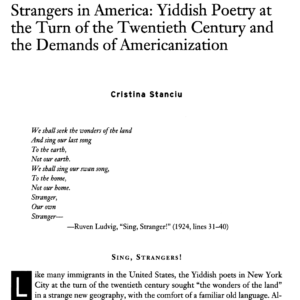
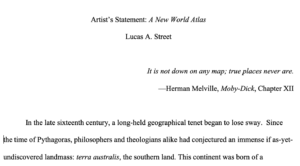
Though an epigraph is always a quotation, it is not usually enclosed in quotation marks, since it’s already set off from the main text. Depending on the publisher’s preference, the epigraph may be italicized or not. Further, it may be either indented as a block quotation would be (see first example below) or simply right-justified (see second example).
On the line directly below the epigraph, the writer should create a further-indented or right-justified attribution for the quotation. This is accomplished by typing an em-dash (–) and the author’s name, usually followed by the title of the piece being quoted. If the original text is contained in a larger work, the usual MLA rules about formatting containers apply: enclose the title of the shorter work in quotation marks, and the container in italics.
At times, writers may wish to pinpoint exactly from where in the original text the epigraph is drawn (e.g., the publication date and line numbers for the poem epigraph in the first example below, or the book chapter in the second example), but this isn’t usually necessary.
No other bibliographical information is necessary. Do not include the source in your works cited list unless you also refer to the text in the body of your paper (again, this is uncommon).
Epigraph Example: Published Work
Epigraph Example: Student Work
Works Cited
Modern Language Association. “How do I format and document epigraphs in MLA style?” MLA Style Center, 7 May 2018, style.mla.org/styling-epigraphs.
Stanciu, Cristina. “Strangers in America: Yiddish Poetry at the Turn of the Twentieth Century and the Demands of Americanization.” College English, vol. 76, no. 1, Sept. 2013, JSTOR, www.jstor.org/stable/24238193.
Stevenson, Bryan. Just Mercy: A Story of Justice and Redemption. Random House, 2014.
GIVE YOUR CITATIONS A BOOST TODAY
Start your TypeCite Boost 3 day free trial today. Then just $4.99 per month to save your citations, organize in projects, and much more.
SIGN UP
Lucas Street
Lucas A. Street directs the writing center and is an assistant professor of English at Augustana College in Rock Island, Illinois.