How to Cite Chapter in Edited Book in MLA
- Written by Hannah Berry (Ph.D.)
- Reviewed by Amy McInerney
- Published on 03/20/2024
- Updated on 01/04/2026
To cite a chapter from an edited book in MLA format, include the following elements in your citation:
- Chapter Author(s): Begin by acknowledging the authors of the respective chapters within the edited book. Include their names or organizations involved.
- Chapter Title: Enclose the title of the chapter in quotation marks.
- Book Title: Italicize the title of the book.
- Edited By: Indicate that the book has been edited by including “edited by” followed by the names of the editors.
- Version: If applicable, specify the edition of the book (e.g., 2nd ed., revised ed.).
- Publisher: Provide the name of the publisher.
- Publication Date: Include the year of publication.
- Page Extent: Specify the page numbers where the chapter appears in the book. For page numbers with three or four digits, the second number only needs two digits unless it extends into the next hundred or thousand.
- DOI: If the book is located online, you’ll need to include the DOI (Digital Object Identifier), if available, include the DOI.
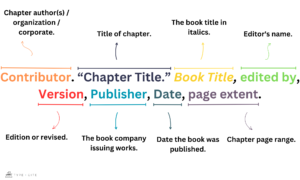
EXAMPLE OF CHAPTER IN AN EDITED BOOK
| Citation |
Kahn, Louise. “Exploring the Effects of Climate Change on Coastal Ecosystems.” Environmental Challenges in the 21st Century, edited by Sarah Lowe, 2nd ed., GreenPress, 2024, pp. 78-92.
|
| Structure |
Chapter Author Surname, Chapter Author First Name. “Chapter Title.” Book Title, edited by Editor First Name Editor Surname, Version, Publisher, Publication Date, pp. page extent.
|
In this example, Louise Kahn authored the chapter “Exploring the Effects of Climate Change on Coastal Ecosystems,” which is included in the book Environmental Challenges in the 21st Century, edited by Sarah Lowe. The book was published by GreenPress in 2024, and Kahn’s chapter spans pages 78 to 92.
EXAMPLE OF A CHAPTER WITH MULTIPLE AUTHORS
Citing a chapter that has multiple authors follows the same general guidelines as if there was one author. To add the second author, you’d write their first name and last name after the first author. An example of this would be:
| Citation |
Woods, Evelyn, and Carri Booker. “Nutrients in Vegetables.” Nutrition, edited by Sophia Turkle, Oxford Hills Press, 2012, pp. 12-25.
|
| Structure |
Chapter Author Surname, Chapter Author First Name, and Chapter Author 2 First Name Chapter Author Surname. “Chapter Title.” Book Title, edited by Editor First Name Editor Surname, Publisher, Publication Date, pp. page extent.
|
IN-TEXT CITATIONS
To cite an edited chapter from a book in-text, you’ll need the author’s last name, as well as the page numbers, if available. It’s important to note that you’ll need the author of the chapter, rather than the author or editor of the book as a whole. An example of an in-text citation would look like:
Nutrients in vegetables are important for healthy digestion (Rudy 55).
In the above citation, Rudy is the last name of the author of the chapter, while 55 refers to the page number on which the fact can be found.
 |
Verify Authorship and Editorship: Before citing a chapter from an edited book, ensure you accurately identify the author of the chapter and the editors of the book. This may involve consulting the title page, copyright page, or table of contents to confirm authorship and editorship details. Include Edition Information When Applicable: If the book you are citing is not a first edition, include the edition information in your citation. This typically appears after the book title, indicating whether it is a second edition, revised edition, or another edition. Edition information helps readers locate the specific version of the book you are referencing. Provide DOI When Available: Whenever possible, include the DOI (Digital Object Identifier) for the chapter in your citation, if you are accessing the book online. DOIs are unique alphanumeric identifiers assigned to digital publications and provide a stable link to the source. Including DOIs in your citations facilitates accessibility and ensures that readers can easily locate the cited material online, if applicable. Check for Special Circumstances: Be mindful of any special circumstances surrounding the chapter you are citing. This could include additional contributors such as translators, if the chapter was originally written in another language, or collaborators if the chapter was co-authored. Ensure that all relevant contributors are appropriately acknowledged in your citation to provide accurate credit and context for the chapter. Create a Separate Citation for Each Chapter: If you are citing several chapters in one book, you’ll need to provide a citation for each chapter referenced. |
GIVE YOUR CITATIONS A BOOST TODAY
Start your TypeCite Boost 3 day free trial today. Then just $4.99 per month to save your citations, organize in projects, and much more.
SIGN UP
Hannah Berry (Ph.D.)
Hannah Berry has lectured at several colleges and teaches at the WEA. Besides publishing extensively, she has taught citation skills and written multiple style guides.