How to Cite a Website in MLA Format
- Written by Tomas Elliott (Ph.D.)
- Reviewed by Lucas Street
- Published on 11/20/2023
- Updated on 02/07/2026
Most often, when citing something they read online, writers should cite that text (e.g., page, article, etc.) as a “short work on a website.” Citing an entire website on the other hand, becomes pertinent when referencing the site’s overall content or when the site’s material forms the basis of an argument or analysis. If the website itself is the primary source (again, not a particular page or article on that site), then citing the entire website is appropriate.
In this guide, we will explore how to cite websites in a way that’s clear and accurate. We’ll break down the important parts and show you how to create MLA citations that are precise and effective, no matter the type of website you’re referencing.
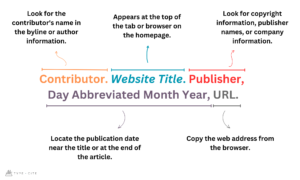
- Author’s Name: When you know the author of the webpage, start the citation with their name. Write it in the format of surname, first name. But if the author is unknown, begin the citation with the title of the website.
- Website Name (in Italics): Following the page title, include–in italics the name of the website. This emphasizes the larger source or platform where the particular content is found. It assists readers in recognizing the broader context of the information. Note that the website name is not the same as the URL. For example, if you were citing the entire TypeCite webpage, you would write TypeCite as the website name, NOT www.typecite.com.
- Publication Date: Displayed as Day Abbreviated Month Year (e.g., 21 Sep. 2025). If the date is missing or content may change, consider adding an access date at the end.
- URL: The citation ends with the URL, the direct web address for accessing the content. It’s listed without the “https://” part for reader convenience and (unless you need to include an access date) ends with a period to show that the citation has concluded.
WEBSITE WITH AN INDIVIDUAL AUTHOR
For websites with a specified author, the citation structure includes the author’s name, the title of the website in italics, the publication date, and the URL.
| Citation |
Taylor, Kathryne. Cookie and Kate. 18 Jan. 2026, www.cookieandkate.com.
|
| Structure |
Author Surname, First Name. Title of the Website. Day Abbreviated Month Year, URL.
|
WEBSITE WITH TWO AUTHORS
| Citation |
Silver, Nate, and Eli McKown-Dawson. Silver Bullet. 18 Jan. 2026, www.natesilver.net. |
| Structure |
Author 1 Surname, Author 1 First Name(s) or Initial(s), and Author 2 First Name(s) &/or Initial(s) Author 2 Surname. Title of the Website. Day Abbreviated Month Year, URL.
|
WEBSITE WITH THREE OR MORE AUTHORS
| Citation |
Jackon, Josh, et al. Paste. 18 Jan. 2026, www.pastemagazine.com.
|
| Structure |
Author 1 Surname, Author 1 First Name(s) or Initial(s), et al. Title of the Website. Day Abbreviated Month Year, URL.
|
CITING WEBSITES WITH NO AUTHOR OR GROUP OR ORGANIZATION AUTHOR
When a website is missing a specified author, or if there is a group or corporate author, then the citation should begin with the title of the website in italics, publisher (if available), followed by the publication date (if available), and the URL.
Sometimes the only date available is the copyright year at the bottom of the website. If so, just use that.
| Citation |
BuzzFeed. BuzzFeed, Inc., 2026, www.buzzfeed.com.
|
| Structure |
Title of the Website. Publisher, Year, URL.
|
CITING WEBSITES WITH NO DATE
For those rare websites that truly have no publication date, it’s essential to include an access date at the end of citation to indicate when you accessed the content.
| Citation |
La Tomatina. www.latomatina.com. Accessed 24 Jan. 2026.
|
| Structure |
Title of the Website. URL. Accessed Day Abbreviated Month Year.
|
WEBSITE WITH DIFFERENT PUBLISHER
Sometimes, a website may have a different publisher than the overall site. In such cases, include details of the specific website, such as the contributor (if available), the title in italics, the publication date (if available), the publisher, and the URL.
| Citation |
Mental Floss. Minute Media, 2026, www.mentalfloss.com.
|
| Structure |
Title of the Website. Publisher, Year, URL.
|
 |
Abbreviate all months longer than four letters. For instance, January becomes Jan, February becomes Feb, and so on. Do not abbreviate the months of May, June, and July. Websites can undergo changes, and URLs may be updated as time goes on. Ensure that the URL you provide is accurate and functional. Ensure uniformity in your citations. Use the same format for elements like author names, publication dates, and titles throughout your bibliography. When formatting your Works Cited page, employ hanging indents. The first line of each entry should be flush with the left margin, and subsequent lines indented. |
By following these guidelines, you’ll be well on your way to accurately citing any website you come across.
GIVE YOUR CITATIONS A BOOST TODAY
Start your TypeCite Boost 3 day free trial today. Then just $4.99 per month to save your citations, organize in projects, and much more.
SIGN UP
Tomas Elliott (Ph.D.)
Tomas Elliott is an assistant Professor of English at Northeastern University London. His research specialisms include the history of theatre and film, European modernism, world literature, film adaptation, transmedia studies and citation practices. He read English and French Literature at Trinity College, Oxford, before completing a Ph.D. in Comparative Literature and Literary Theory at the University of Pennsylvania.